Pi Network has taken a significant technical step forward with the successful rollout of mainnet v21, bringing the project closer to full smart contract functionality and improved network performance. The upgrade, announced on April 14, 2026, includes critical enhancements that pave the way for decentralized application (dApp) development and better scalability across the ecosystem.
The Pi team urged all node operators to update immediately to the latest software version and teased that version 22 will bring even more infrastructure refinements. In parallel, the project launched a Testnet RPC server, allowing developers to build, test, and deploy smart contracts before mainnet integration. This development is a major milestone for Pi Network, which aims to evolve from a mobile mining app into a fully functional Layer-1 blockchain capable of competing with Ethereum, Solana, and other established smart contract platforms.
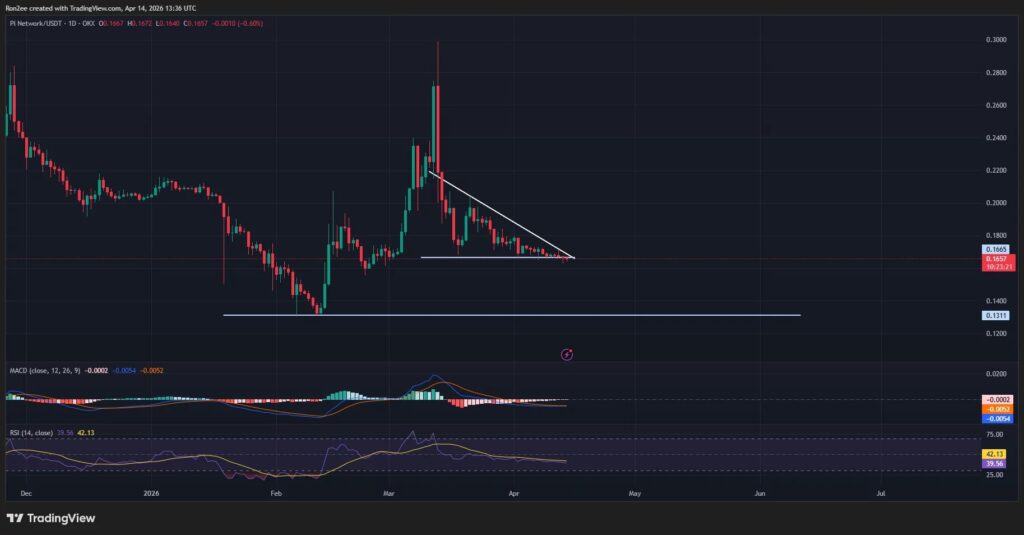
Despite the positive technical progress, Pi token price action remains under pressure. The token rose briefly to $0.167 before reversing, currently trading around $0.165 (down ~0.63% on the day). Over the past month, Pi has declined approximately 15%, forming a clear descending triangle on the daily chart — a classic bearish continuation pattern.
Technical Analysis: Bearish Breakdown Confirmed
On the daily timeframe, Pi has broken below the lower trendline of the descending triangle at $0.166, confirming the bearish structure. Momentum indicators reinforce the downside bias:
- MACD is trending lower with increasing bearish momentum.
- RSI is pointing downward, showing sustained selling pressure.
The path of least resistance points toward the February 11 low near $0.131 if selling pressure continues. A breakdown below $0.15 could accelerate the move toward that level. On the upside, a reclaim of $0.18 with strong volume would be needed to invalidate the bearish pattern and open the door to a recovery toward $0.22–$0.25.
What the v21 Upgrade Means for Pi Network’s Future
The upgrade focuses on three key areas:
- Performance enhancements for faster transaction processing and better network stability.
- Smart contract readiness via the Testnet RPC server, enabling developers to experiment with dApps in a controlled environment.
- Ecosystem expansion by making Pi more attractive for builders in DeFi, NFTs, gaming, and payments.
Once smart contracts go live on mainnet, Pi could see a surge in utility and adoption. The project already boasts a massive user base from its mobile mining phase. The challenge now is converting that user base into active on-chain participants and attracting developers to build meaningful applications.
This upgrade aligns with Pi’s long-term vision of becoming a user-friendly blockchain for everyday people, especially in emerging markets like Africa, where mobile-first adoption is high. Successful execution could position Pi as a serious contender in the Layer-1 space.
Broader Market Context & Risks
Pi’s price weakness comes amid a choppy broader crypto market. Bitcoin is consolidating near $70,000–$72,000 amid ongoing Iran conflict headlines, oil volatility, and macro uncertainty (sticky inflation, Fed policy). Altcoins are rotating selectively, with some DeFi and AI tokens showing relative strength while others lag.
For Pi specifically, the upgrade is fundamentally bullish, but the token remains highly speculative. It has yet to achieve full mainnet openness for all users, and regulatory clarity around its tokenomics and distribution model is still evolving. The bearish technical structure suggests near-term caution is warranted.
Trading Levels & WallStreetQueenOfficial Edge
Current Pi range: $0.15–$0.18 (recent consolidation).
- Bull case: Reclaim $0.18 with volume → targets $0.22–$0.25. Strong developer adoption post-upgrade could fuel a narrative-driven rally.
- Bear case: Breakdown below $0.15 → retest $0.131 (February low). Failure to hold $0.15 opens further downside.
- Volatility note: High-beta token — headline and upgrade news can trigger sharp moves. Use tight risk management on leveraged positions.
WallStreetQueenOfficial has been navigating altcoin rotations and upgrade-driven volatility with precision:
- Selective longs on relative strength plays (ETH, SOL, TAO, etc.) during recent rotations.
- Recent winners: 123%+ EGLD short during flush, 118%+ GALA reversal, 106%+ QNT long on DeFi strength, multiple 70–120%+ altcoin calls.
We deliver:
- Real-time alerts on protocol upgrades, Testnet developments, and key technical levels for Pi and other altcoins.
- High-accuracy signals blending on-chain metrics, developer activity, and macro overlays.
- Live breakdowns of smart contract roadmaps and their impact on token utility and price.
- VIP community discussion tuned to WAT (Benin City time) for traders across Nigeria and global markets.
Pi Network’s v21 upgrade is a meaningful step toward becoming a fully functional smart contract platform. While the technical progress is bullish long-term, the current descending triangle and bearish momentum indicators suggest near-term caution. The token could find support near $0.131, but a confirmed breakout above $0.18 would shift the bias higher.
The coming weeks will be critical as developers begin testing on the RPC server and version 22 details emerge. From Benin City to the global Pi community, WallStreetQueenOfficial turns protocol upgrades, technical setups, and ecosystem momentum into high-conviction, profitable trades.
Ready to trade Pi Network and the next altcoin rotation? Join our VIP channel for exclusive signals, live chart breakdowns, and real-time commentary.
PiNetwork #PiUpgrade #SmartContracts #PiToken #WallStreetQueenOfficial #CryptoTrading #LeverageTrading #Altcoins2026
Disclaimer: Cryptocurrency trading involves substantial risk of loss and is not suitable for everyone. This is not financial advice — always DYOR, manage risk properly, and consult professionals if needed. 🚀💰
Leave a Reply